



Educational institutions worldwide rely on measurable standards to evaluate success, and the academic performance indicator has emerged as a crucial tool for assessing both student achievement and faculty contributions. Understanding what an academic performance indicator is, how scores are calculated, and why they matter helps educators, administrators, and students navigate the complex landscape of academic assessment.
Research indicates that academic performance is positively correlated with various factors, including teaching quality, resource availability, and institutional support systems. This comprehensive guide explores the academic performance indicator framework, calculation methods, and practical applications across educational settings.
What Is an Academic Performance Indicator
Defining the Concept
An academic performance indicator represents a quantifiable measure used to evaluate educational outcomes, teaching effectiveness, or research productivity. These indicators provide objective data that institutions use to assess quality, allocate resources, and identify areas needing improvement.
The academic performance indicator format varies depending on context—student assessments differ from faculty evaluations, and institutional metrics measure different aspects of academic excellence. However, all share the common goal of quantifying educational achievement through standardized criteria.
Types of Performance Indicators
Indicators for academic performance fall into several categories:
Student-Level Indicators:
- Grade point averages and test scores
- Graduation rates and time-to-degree
- Course completion rates
- Student engagement metrics
- Learning outcome assessments
Faculty-Level Indicators:
- Research publications and citations
- Teaching evaluations
- Grant funding secured
- Professional development activities
- Service contributions
Institutional Indicators:
- Accreditation status
- Student retention rates
- Employment outcomes for graduates
- Research output and impact
- Resource utilization efficiency
UGC Academic Performance Indicator

Understanding the UGC API Framework
The University Grants Commission (UGC) in India developed a comprehensive academic performance indicator UGC systemm,m to evaluate faculty members for career advancement and assessment purposes. The academic performance indicator API provides a standardized method for measuring academic contributions across research, teaching, and service domains.
The UGC academic performance indicator framework assigns numerical values to various academic activities, creating an academic performance indicator API score that reflects overall contributions. This systematic approach enables transparent, objective evaluation of faculty performance across diverse institutions.
Academic Performance Indicator for an Assistant Professor
The academic performance indicator for assistant professor evaluations considers specific criteria appropriate to early-career academics:
- Publications in peer-reviewed journals
- Conference presentations and papers
- Teaching assignments and student feedback
- Curriculum development contributions
- Participation in workshops and training
- Extension and outreach activities
- Administrative responsibilities
Each category carries specific point values detailed in the academic performance indicator ugc guidelines, with minimum scores required for promotions and confirmations.
API Score Components
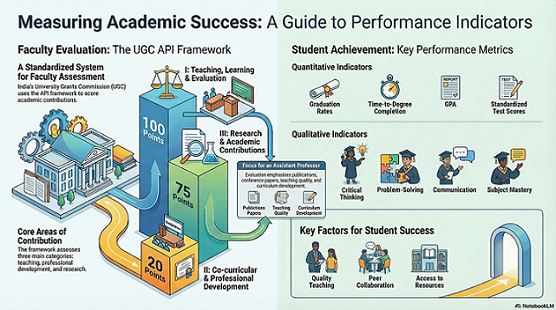
The academic performance indicator from UGC outlines three main assessment categories:
Category I: Teaching, Learning, and Evaluation Activities (100 points maximum)
- Classroom teaching hours
- Student supervision and guidance
- Curriculum and course material development
- Examination duties
- Training and development programs
Category II: Co-curricular, Extension, and Professional Development (20 points maximum)
- Student welfare activities
- Extension lectures and outreach
- Professional development courses attended
- Participation in academic bodies
Category III: Research and Academic Contributions (75 points maximum)
- Published research papers
- Books and chapters authored
- Research projects and grants
- Patents and innovations
- Conferences and seminars
Academic Performance Indicator Calculation
The academic performance indicator calculation follows a structured point system where faculty members document activities and self-assess their scores. The academic performance indicator score calculation involves:
- Documentation: Gathering evidence for all academic activities
- Self-Assessment: Assigning points based on UGC guidelines
- Verification: Department and institutional review of claimed points
- Final Score: Calculation of the total API score from all categories
The academic performance indicator ugc 2018 guidelines (and subsequent updates) provide detailed scoring rubrics ensuring consistency across institutions.
Using the Academic Performance Indicator Calculator
While manual calculation remains standard, some institutions have developed an academic performance indicator calculator tool to streamline the process. These calculators help faculty members:
- Input activities across various categories
- Automatically apply UGC point values
- Generate preliminary API scores
- Identify areas needing additional documentation
- Track progress toward promotion requirements
However, official submissions still require manual documentation and verification by screening committees.
Indicators of Academic Performance for Students

Key Student Performance Metrics
Indicators of the academic performance of students encompass various measures beyond simple grades:
Quantitative Indicators:
- Cumulative GPA and semester grades
- Standardized test scores
- Course pass rates
- Credit hours completed versus attempted
- Time to degree completion
Qualitative Indicators:
- Critical thinking development
- Problem-solving abilities
- Communication skills
- Collaborative work capabilities
- Subject matter mastery
Understanding indicators of students’academic performance helps educators design interventions and support systems targeting specific improvement areas.
Academic Performance Questionnaire with Indicators
Educational researchers often use an academic performance questionnaire with indicators to gather data about factors affecting student success. These questionnaires typically explore:
- Study habits and time management
- Resource utilization (library, tutoring, office hours)
- Motivation and engagement levels
- Home and family support
- Health and wellness factors
- Financial stress and employment
Data from these instruments helps institutions understand what indicators of academic performance research shows as most predictive of student success.
Research on Student Performance Indicators
Extensive research on indicators of academic performance demonstrates that student achievement results from complex interactions between individual characteristics, institutional factors, and external circumstances. Research indicates that academic performance is positively influenced by:
- Quality of instruction and faculty engagement
- Access to academic resources and support services
- Peer interaction and collaborative learning opportunities
- Clear academic expectations and feedback
- Institutional culture emphasizing student success
These findings guide institutional policy and resource allocation decisions.
Academic Library Key Performance Indicators
Measuring Library Contributions to Academic Success
Academic library key performance indicators assess how effectively library resources and services support educational missions. These specialized indicators include:
Collection Metrics:
- Materials budget allocation and expenditures
- Collection size and growth rates
- E-resource subscriptions and usage
- Collection circulation statistics
- Interlibrary loan requests and fulfillment
Service Indicators:
- Reference transactions and research consultations
- Information literacy instruction sessions
- Study space utilization
- Technology availability and usage
- User satisfaction surveys
Libraries increasingly demonstrate their value through data showing correlations between library resource use and student academic performance.
Digital Era Library Metrics
Modern academic library key performance indicators now emphasize digital resource usage:
- Database search sessions
- Full-text article downloads
- E-book checkouts
- Online chat reference interactions
- Virtual instruction attendance
These metrics help libraries justify budgets and demonstrate ongoing relevance in digital learning environments.
Key Performance Indicators for Academics

Faculty Performance Assessment
Key performance indicators for academics extend beyond the UGC API to include institutional-specific metrics:
Research Productivity:
- Publications in high-impact journals
- Citation counts and h-index
- Grant applications and funding secured
- Collaborative research networks
- Research student supervision
Teaching Excellence:
- Student evaluation scores
- Course development innovations
- Pedagogical research and scholarship
- Mentoring and advising quality
- Curriculum leadership
Service Contributions:
- Committee participation
- Professional organization involvement
- Community engagement
- Peer review activities
- Administrative responsibilities
Academic Performance Indicator Format
The standard academic performance indicator format requires faculty to document achievements across assessment periods (typically annual or as needed for promotions). The academic performance indicator PDF submission generally includes:
- Personal and professional information
- Detailed activity logs with supporting evidence
- Self-assessed point calculations
- Supporting documentation (publications, certificates, letters)
- Reflective statements on contributions
Institutions may customize formats while adhering to core UGC requirements for faculty in India or developing equivalent frameworks in other countries.
Academic Performance Indicators PDF Resources
Documentation and Guidelines
Various academic performance indicators PDF documents provide guidance:
- UGC official API guidelines and scoring matrices
- Institutional policy documents
- Sample completed API forms
- Case studies and examples
- Training materials for faculty
The academic performance indicators examples found in these resources help faculty understand expectations and properly document their contributions.
Accessing Resources
Faculty can obtain indicators of academic performance,,e PDF materials from:
- University Grants Commission official website
- Institutional human resources departments
- Academic affairs offices
- Professional development centers
- Faculty association resources
Staying current with updated guidelines ensures compliance with evolving standards.
“Academic Performance is the Best Indicator of Potential for a Successful Life”
Examining the Assertion
The statement “Academic performance is the best indicator of potential for a successful life” generates considerable debate in educational circles. While academic achievement correlates with certain success measures, viewing it as the “best” indicator oversimplifies complex relationships between education and life outcomes.
Research shows academic performance predicts:
- Career entry opportunities
- Initial earning potential
- Professional network access
- Continued learning capacity
However, success in life also depends on:
- Emotional intelligence and social skills
- Adaptability and resilience
- Creativity and innovation
- Ethical character and integrity
- Physical and mental health
A Balanced Perspective
Academic performance indicators serve important purposes in educational contexts but represent only one dimension of human potential. Comprehensive assessment considers multiple indicators, recognizing diverse talents, experiences, and contributions individuals bring to society.
Frequently Asked Questions
What is an academic performance indicator?
An academic performance indicator is a quantifiable measure used to evaluate educational outcomes, teaching effectiveness, or research productivity. In India, the UGC academic performance indicator (API) specifically assesses faculty contributions across teaching, research, and service for promotion and career advancement decisions.
How is the academic performance indicator API score calculated?
The academic performance indicator calculation follows a point-based system where faculty document activities in three categories: teaching and learning (100 points max), extension and professional development (20 points max), and research contributions (75 points max). Points are assigned based on UGC guidelines, with evidence verified by institutional committees.
What are the main indicators of academic performance for students?
Key indicators of the academic performance of students include GPA and course grades, standardized test scores, graduation rates, course completion rates, time to degree, learning outcome assessments, and qualitative measures like critical thinking development and problem-solving abilities. These indicators help institutions assess student success and identify areas needing support.
What is the academic performance indicator for an assistant professor?
The academic performance indicator for assistant professor evaluation assesses early-career faculty contributions, including publications, teaching assignments, student supervision, curriculum development, professional development activities, and service contributions. Minimum API scores are required for confirmation and promotion to higher positions.
Where can I find academic performance indicators PDF resources?
Academic performance indicators PDF resources are available from the UGC official website, institutional human resources departments, academic affairs offices, and professional development centers. These documents include official guidelines, scoring matrices, sample forms, and examples,s helping faculty understand requirements and properly document their achievements.
Conclusion
The academic performance indicator serves as an essential tool for evaluating educational quality, faculty contributions, and student achievement across institutional contexts. Whether examining the UGC academic performance indicator API framework, student performance metrics, or academic library key performance indicators, these measurement systems provide objective data supporting decision-making and continuous improvement.
Understanding academic performance indicator calculation methods, documentation requirements, and scoring criteria helps faculty members navigate evaluation processes successfully. For students, recognizing indicators students”nts academic performance enables self-assessment and informed choices about study strategies and resource utilization.
As educational landscapes evolve with technological advances and changing societal needs, academic performance indicators will continue adapting. Future developments may incorporate more sophisticated data analytics, emphasize qualitative alongside quantitative measures, and recognize diverse forms of academic contribution beyond traditional research and teaching metrics.
While research indicates that academic performance is positively related to various success measures, maintaining balanced perspectives that value multiple forms of intelligence, creativity, and human contribution remains essential. Academic performance indicators provide valuable information but represent only part of the complex picture of educational excellence and human potential.